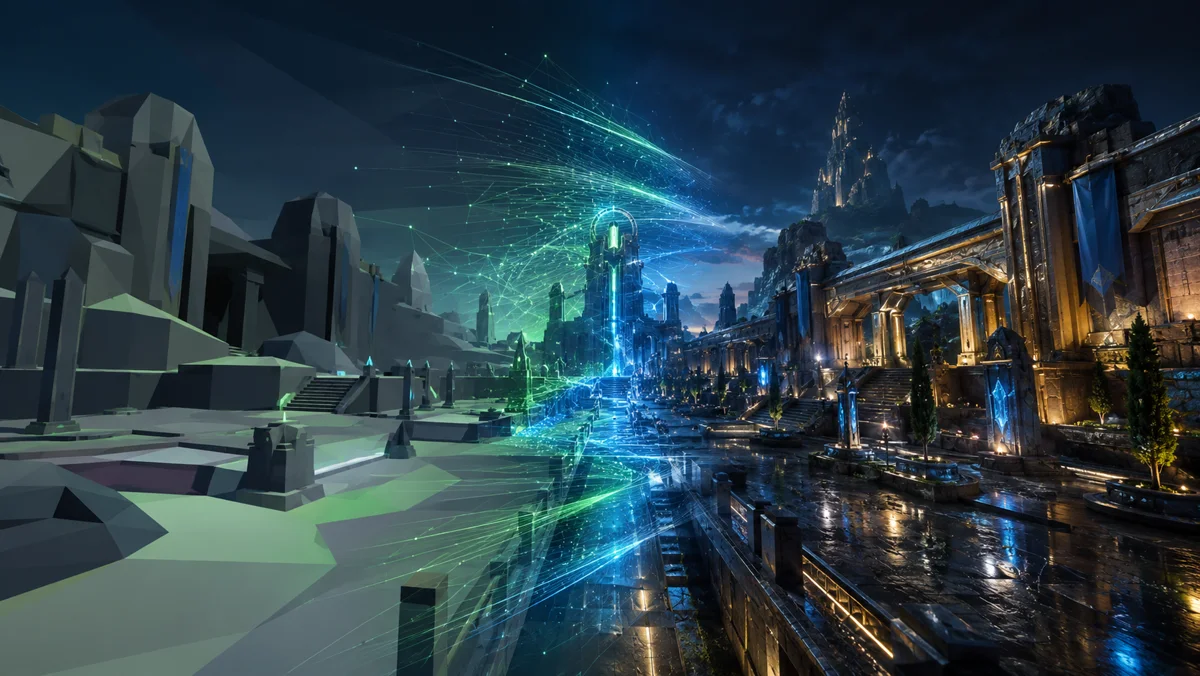
DLSS 5 promises real-time neural rendering with richer lighting and materials, but independent studios still win through scope, device strategy, art direction, and playable proof. The strongest results come from a focused operating system, measurable quality standards, and human accountability—not shortcuts.
NVIDIA is positioning DLSS 5 as its biggest graphics breakthrough since real-time ray tracing. Announced in March and expected this fall, the system uses a real-time neural rendering model to enrich lighting and materials while staying anchored to the developer’s 3D scene.
For a small AI-powered studio, that sounds like a shortcut from prototype geometry to cinematic realism. It is not. Neural rendering can improve what reaches the screen, but it cannot decide which neighborhood deserves detail, whether a mission is fun, how a character should move, or whether the game loads on the device the player actually owns.
The practical opportunity is to design a layered production strategy: build reliable worlds and interactions first, then use higher-end rendering where the hardware, budget, and audience justify it.
DLSS 5 moves AI from performance toward appearance
Earlier DLSS generations became known for super resolution and frame generation. NVIDIA says DLSS 5 goes further by using color and motion-vector inputs to add photoreal lighting and material behavior in real time, including difficult effects involving hair, fabric, translucent skin, and changing environmental light.
The important word is anchored. Unlike an offline prompt that can invent a new result every time, a game renderer must remain consistent with geometry, animation, camera motion, collision, and the developer’s authored intent from frame to frame.
- Real-time neural rendering
- Up to 4K output described by NVIDIA
- Color and motion vectors as inputs
- Artist controls for intensity, grading, and masking
- Integration through NVIDIA Streamline
Better pixels cannot rescue an unfinished world
A visually dramatic street is still not a game if the player cannot enter it, move naturally, complete a task, or understand what is happening. Small teams are especially vulnerable to polishing screenshots before proving traversal, combat, population, saving, networking, and device performance.
For JC the Holy OG, the honest order is movement, one finished gameplay block, stable loading, readable combat, NPC and traffic behavior, and mission flow. A future neural-rendering tier could enhance materials and lighting, but it should sit on top of a world that already works.
- Prove the core loop before the graphics tier
- Keep geometry and collision authoritative
- Measure frame time and memory on target hardware
- Treat visual enhancement as optional capability
- Never call a cinematic still a playable milestone
Mobile-first changes the decision
DLSS 5 is tied to NVIDIA’s RTX ecosystem, while iLLCo Games is building around mobile and web access as well as desktop growth. That requires more than turning features off. The world needs a performance ladder that preserves identity across devices.
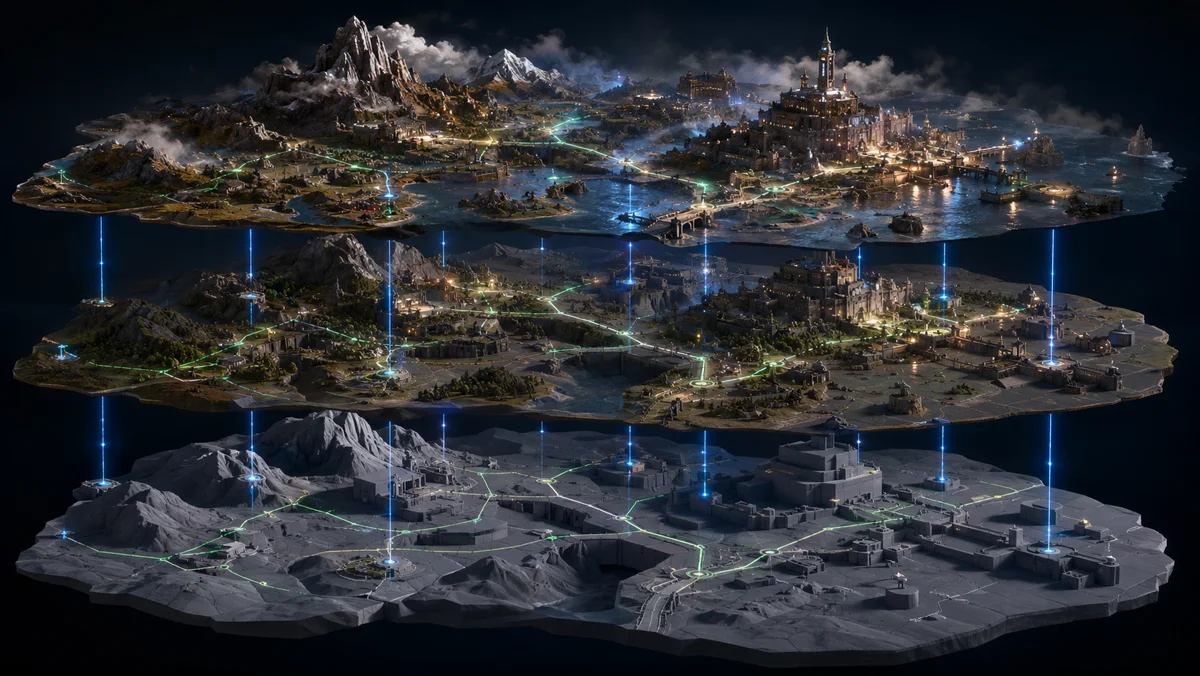
A useful ladder begins with terrain, roads, structures, navigation, gameplay objects, and deliberate art direction. Higher tiers can add denser geometry, shadows, reflections, advanced materials, and neural enhancement. The player should recognize the same place and mechanics at every tier.
- Low tier: stable geometry, gameplay, and readable materials
- Mid tier: denser props, lighting, particles, and crowds
- High tier: advanced reflections, materials, and neural rendering
- Shared world coordinates and gameplay rules across tiers
- Device detection with conservative defaults
WorldForge should produce evidence, not just images
WorldForge is iLLCo AI’s direction for turning real-world geography into game-ready foundations. Its value is not that an AI can make a road look wet or a building look expensive. Its value is that the studio can record which coordinates, terrain, roads, features, and transformations created the playable region.
That evidence layer becomes more important as rendering becomes more synthetic. A beautiful frame should still be traceable to the right district, the right gameplay object, and the right production decision. Otherwise visual realism can hide world-building errors instead of solving them.
- Known coordinate reference and bounds
- Indexed terrain, roads, and structures
- Documented approximations and fictionalization
- Accepted alignment tests
- Separate world truth from rendering enhancement
The small-studio advantage is disciplined ambition
Large publishers will be first to deploy the most expensive graphics stacks at scale. Independent studios can still compete by moving faster around a clear thesis, choosing distinctive worlds, and using technology only where it strengthens the experience.
For iLLCo Games, that means a recognizable Las Vegas-inspired supernatural world, a location-aware fishing platform, and a reusable real-place pipeline. DLSS 5 is a signal about where visual fidelity is going. It is not permission to skip the production gates required to ship.
Frequently asked questions
What is DLSS 5?
NVIDIA describes DLSS 5 as a real-time neural rendering system that enriches lighting and materials while remaining anchored to a developer’s 3D scene and motion data.
Will DLSS 5 work on every device?
No. NVIDIA announced it for its RTX ecosystem. Cross-device studios still need separate performance and rendering strategies for mobile, web, integrated graphics, and non-RTX hardware.
Can neural rendering replace 3D artists?
It can change portions of the rendering workflow, but developers still need geometry, animation, gameplay, art direction, optimization, controls, and final visual judgment.
How does this affect iLLCo Games?
It reinforces a layered approach: build stable gameplay and real-world foundations first, then add higher-end visual tiers when the target hardware and business case support them.
About this guide
This article was developed from iLLCo AI’s hands-on work building creator tools, multi-agent workflows, media systems, and business automations. AI assisted the production process; Aaron Allton reviewed, directed, and takes responsibility for the published guidance.