JC the Holy OG
A real city becomes a supernatural playground—built for flight, combat, exploration, missions, and a constant struggle between grace and chaos.
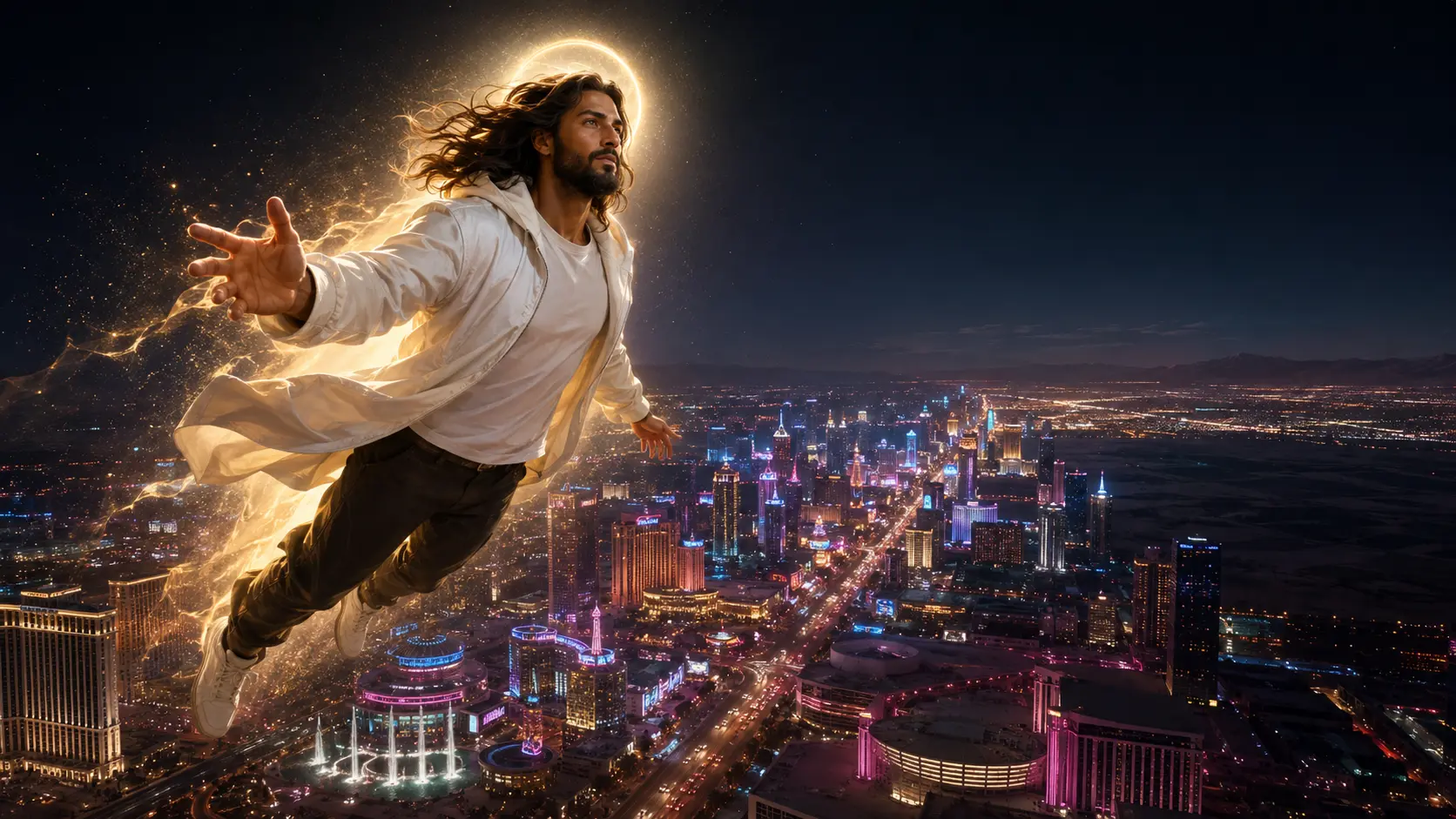
JC the Holy OG begins with a deliberately outrageous question: what if a player could move through a recognizable Las Vegas as a supernatural street-level hero—floating above traffic, diving between rooftops, confronting the Devil, and discovering sacred weapons and strange Easter eggs hidden inside an open world?
The answer is not meant to be a generic city with a religious costume placed on top. iLLCo Games is building the project around the contrast itself: ancient mythology against neon streets, divine power against ordinary city life, and enormous abilities inside a world that still needs rules, missions, people, traffic, neighborhoods, and consequences.
Turn a real place into a playable myth.
Las Vegas is more than a backdrop. It gives the game an identity no fictional grid could reproduce: the Strip’s vertical spectacle, Fremont’s compressed energy, Henderson’s neighborhoods, desert highways, mountains, drainage tunnels, Lake Mead, Boulder City, Hoover Dam, and the long empty distance toward Area 51. Each area creates a different rhythm for movement, missions, pursuit, and discovery.
The creative center is JC himself. He is designed as a powerful but physical character—not a detached camera with unlimited magic. Flight needs acceleration, banking, landing, falling, recovery, and readable animation. On the ground, the same character needs weight, balance, traversal, hand-to-hand movement, aiming, driving, and interaction with the city around him.

Freedom with weight—not floating without purpose.
The game’s strongest promise is vertical freedom. A player should be able to rise from street level, clear a building, accelerate across the skyline, then return to the ground without the experience feeling like three unrelated control systems. That requires a connected movement model: idle hovering, sprinting, jumping, climbing, controlled flight, fast flight, combat entry, landing, and recovery all need to transition naturally.
Street movement, rooftops, flight, vehicles, skateboarding, climbing, and fast transitions between them.
Responsive close-range action, supernatural powers, aimed weapons, defensive movement, and clear enemy behavior.
NPCs, traffic, police response, interiors, day and night, missions, and systems that react to the player.
A complete single-player path with focused two-player online conflict—not mandatory massive multiplayer.
The intended tone is bold and irreverent without becoming disposable parody. JC can carry a pistol, summon power, fly, or chase the Devil through a portal, but the world works only if the player believes in its internal logic. That is why animation, camera behavior, traffic, NPC reactions, mission structure, and performance are as important as the headline abilities.
WorldForge starts with evidence.
The technical direction behind JC is WorldForge: iLLCo AI’s reusable real-world-to-game-world pipeline. The current data foundation uses a 35 × 35 kilometer Las Vegas grid, terrain elevation, roads, and hundreds of thousands of mapped features. The long-term goal is not to copy private property or every trademarked facade. It is to preserve the spatial logic that makes a place recognizable—terrain, blocks, road networks, building footprints, districts, movement corridors, and the relationship between them.
That foundation creates a reusable production problem: turn geographic evidence into terrain tiles, aligned roads, buildings, navigation, visual assets, and gameplay-ready identity records without inventing confidence that the source data does not support. Solving that well matters beyond one game. Racing, survival, crime, hunting, and other location-driven genres can reuse the same underlying approach.

JC versus the Devil is the spine, not the whole world.
The central rivalry gives the game a clean dramatic engine. JC represents power under control; the Devil represents temptation, chaos, and shortcuts. Both need distinct movement, abilities, and visual language. The Devil’s portals can connect Earth to Hell, while JC’s flight connects street level to the skyline and, eventually, Earth to Heaven. Around them, ordinary people make the stakes readable.
Development concepts include selectable JC skin tones, a persistent divine glow, the Holy Sid jersey hidden as a mall Easter egg, the Ark of the Covenant as a rare weapon, supernatural vehicles, sacred collectibles, and later seasonal mythology. These are creative directions, not a claim that every feature is complete today. The priority is a stable core loop that feels good on an iPhone-sized screen before the world expands.
What is real now—and what comes next.
JC the Holy OG is not publicly launched. An internal browser prototype exists, and the project has established its central characters, Las Vegas data foundation, movement direction, visual identity, and core game premise. Production terrain outputs, the accepted world transform, the geographically indexed building registry, finished sprite/model sets, population systems, and fully validated online play remain active development work.
- Internal browser prototype
- JC and Devil game premise
- Las Vegas terrain and feature foundation
- Mobile-first control direction
- Single-player and two-player design target
- One finished Fremont gameplay block
- Stable loading on iPhone 11-class hardware
- Natural movement and combat transitions
- NPC, traffic, police, and mission loop
- Evidence-tested world alignment