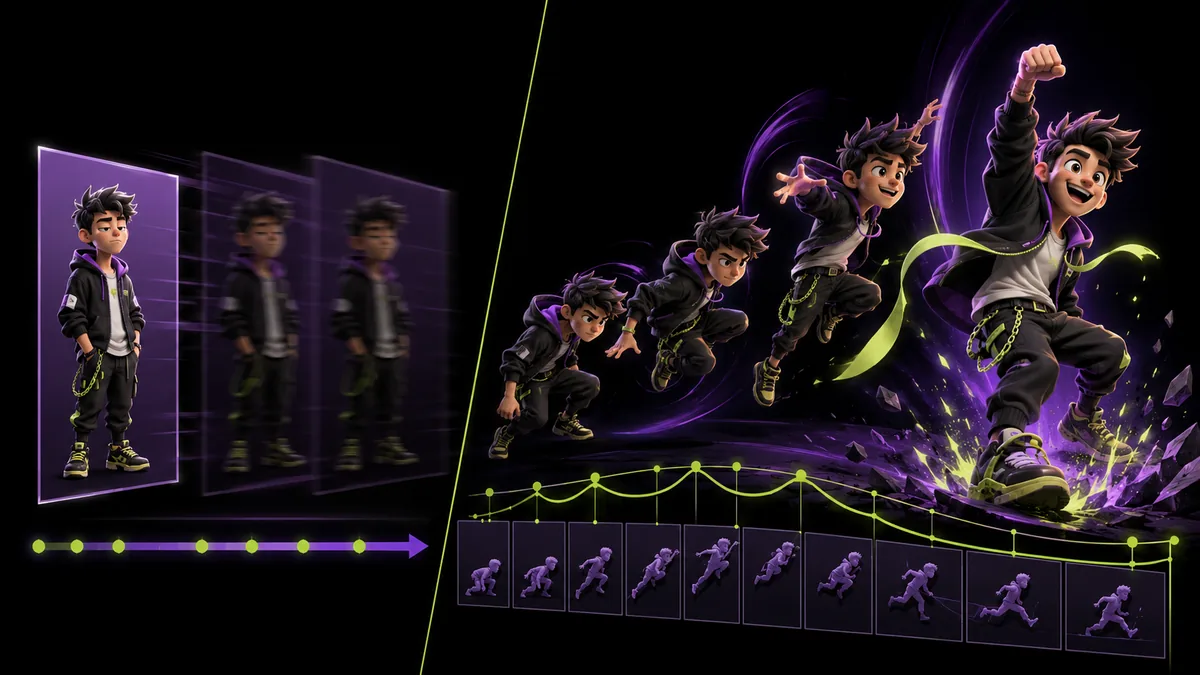
A production guide to character consistency, pose planning, in-betweens, lip-sync, camera language, sound, and frame-level quality control. The strongest results come from a focused operating system, measurable quality standards, and human accountability—not shortcuts.
Most AI animation fails in a recognizable way: the whole picture drifts while the character barely performs. A zoom, pan, or morph can create motion on screen, but it does not automatically create acting.
Real animation communicates intention through pose, timing, spacing, weight, anticipation, follow-through, facial performance, and sound. AI can accelerate asset creation and interpolation, but the production still needs those fundamentals.
This workflow is designed for music videos, shorts, explainers, and character-led stories where identity must remain stable across many shots.
Lock the character before animating
Create a production character sheet with front, three-quarter, side, and back views; full-body proportions; facial expressions; hand shapes; key costumes; and a controlled palette. Include negative constraints for features that must never change.
Identity should be represented by more than a reference image. Record face shape, feature spacing, silhouette, height ratios, hair geometry, wardrobe construction, and material behavior. The more observable the rules, the easier it is to reject drift.
- Turnaround and proportion sheet
- Expression and phoneme mouth library
- Hands, props, wardrobe, and texture rules
- Lighting-neutral identity references
Storyboard performance, not just images
Every shot needs a purpose, duration, framing, emotional beat, start pose, end pose, and continuity requirement. A storyboard should show what changes inside the shot—not merely what the shot looks like.
For music, mark beats, bar changes, lyric stresses, pauses, and transitions. Decide which moments deserve full character animation and which can use controlled holds, effects, environment motion, or camera movement.
- Shot objective and emotional beat
- Key lyric or dialogue timing
- Entry pose, contact pose, and exit pose
- Camera, background, and continuity notes
Build motion from key poses and breakdowns
Generate or draw the strongest storytelling poses first. Add breakdown poses that define arcs, perspective, balance, and limb paths. Only then create in-between frames. Blind interpolation between weak endpoints usually produces rubbery anatomy and inconsistent timing.
Use timing charts or frame targets. Fast actions need readable extremes and fewer transitional frames. Emotional acting often needs longer holds with small face, hand, shoulder, and breathing changes.
- Anticipation before major action
- Clear extremes with readable silhouette
- Arcs for hands, head, and center of mass
- Overlap for hair, clothing, and secondary motion
Make lip-sync follow phonemes and performance
Lip-sync is not random mouth opening. Convert dialogue or lyrics into timed phoneme groups, then map those groups to a practical viseme set. Add jaw, cheeks, brows, blinks, head movement, and breath so the face feels like it is speaking rather than swapping stickers.
Perfect mouth accuracy can still look dead when the upper face and body do nothing. Prioritize stressed syllables, closures for consonants, open vowels, and emotional phrasing. Review at actual playback speed.
- Neutral and closed-mouth shapes
- Wide, round, open, teeth, and lip-contact visemes
- Blink and brow timing
- Head and torso accents on stressed words
Use camera movement intentionally
Camera motion should reveal information, amplify emotion, or manage energy. It should not be used to disguise a frozen character in every shot. Keep parallax layers separate when the scene needs dimensional movement.
Choose stable shot grammar: wide shots establish space, mediums carry performance, close-ups emphasize emotion or evidence, and inserts show important objects. Excessive motion weakens readability—especially on vertical mobile video.
- Define focal point before moving the camera
- Use foreground, subject, and background layers for parallax
- Preserve screen direction and eyelines
- Keep lyrics and captions inside safe zones
Run frame-level quality control
Automated checks can flag sudden color changes, face drift, duplicate frames, flicker, black frames, audio silence, and duration mismatch. Human review must still inspect acting, continuity, clarity, and emotional truth.
Review the render three ways: frame-by-frame for defects, at normal speed for performance, and on the target phone or screen for readability. Fix the earliest source of the error instead of stacking effects over a broken shot.
- Identity and anatomy consistency
- Background and wardrobe continuity
- Audio sync and loudness
- Caption timing and mobile readability
- Final codec, frame rate, duration, and playback
Frequently asked questions
How do I keep an AI character consistent?
Use a detailed character bible, multiple identity references, locked observable traits, controlled shot prompts, and automated plus human drift review.
How many mouth shapes are needed for lip-sync?
A practical set of roughly 8 to 15 visemes can work well when timing, jaw motion, upper-face acting, and stressed syllables are handled carefully.
Is 24 fps required for AI animation?
No. The delivery can be 24 fps while character drawings are held for multiple frames. Motion quality depends on timing and pose design, not generating a unique image for every frame.
Why does AI animation look like the picture is sliding?
The system is often applying camera translation to a flat image instead of changing the character’s pose and internal movement. Separate camera, environment, and character animation plans.
About this guide
This article was developed from iLLCo AI’s hands-on work building creator tools, multi-agent workflows, media systems, and business automations. AI assisted the production process; Aaron Allton reviewed, directed, and takes responsibility for the published guidance.