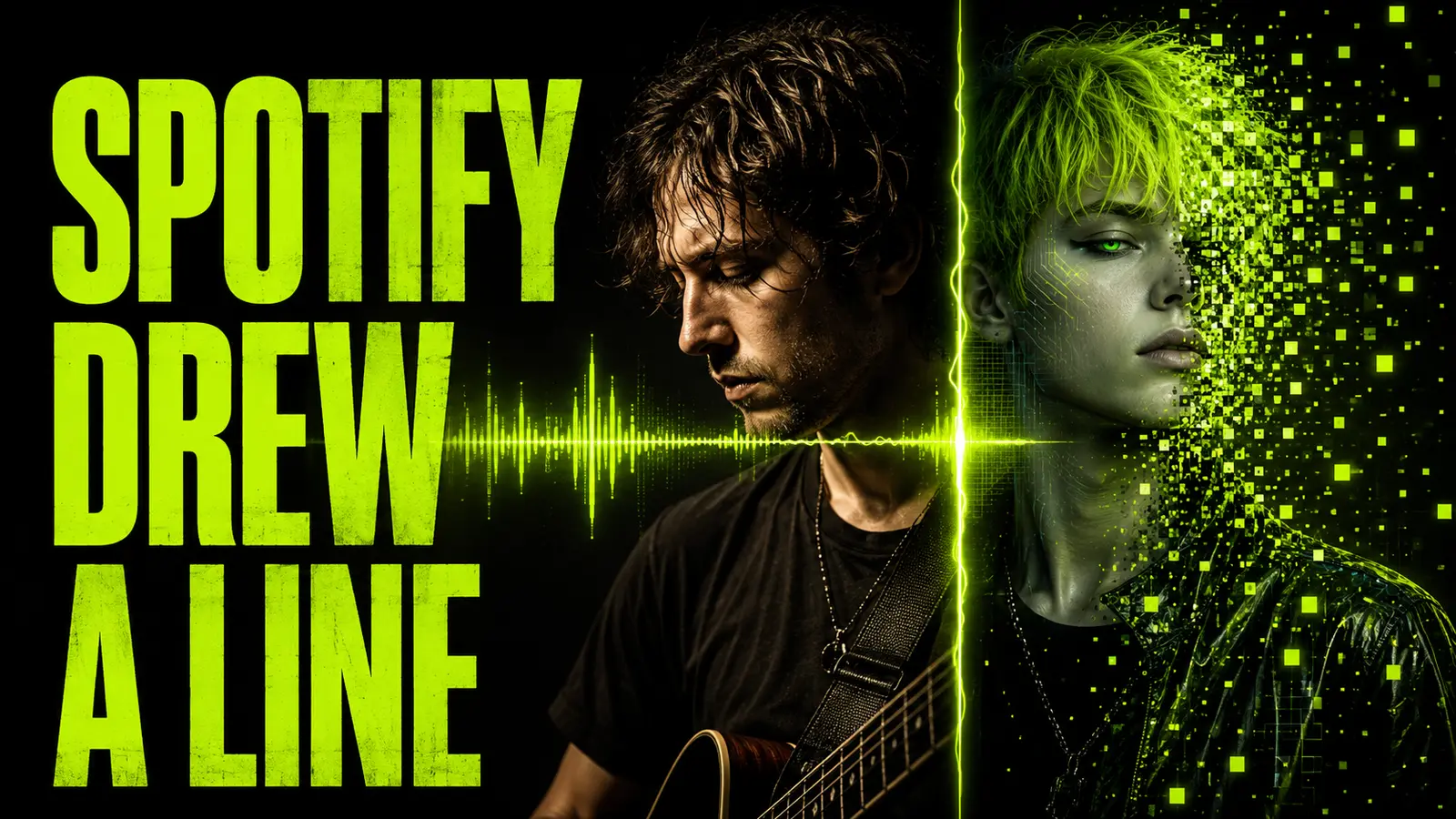
Spotify’s new AI Persona badge is about whether an artist identity represents a real person—not simply whether AI touched the music. Here is the practical identity, credit, and release-proof checklist independent musicians need before the rollout begins. The strongest results come from a focused operating system, measurable quality standards, and human accountability—not shortcuts.
Spotify has now separated two questions that the music business often collapses into one: who the artist claims to be, and how the music was made. The company says its AI Persona badge will identify profiles whose public identity may be AI-generated and does not represent a real person. That is different from an artist using AI somewhere in writing, production, cleanup, artwork, or marketing.
Spotify announced the label on August 11, 2026 and said badges would begin appearing in mid-September. They are expected on artist profiles, in search, and beside tracks inside playlists. Spotify also says AI Personas will be excluded by default from editorial and algorithmic recommendations unless a listener follows them.
The useful response is not panic or an attempt to hide every AI-assisted step. Independent musicians need an identity-and-provenance workflow: a clear human artist presence, accurate credits, permission records, consistent profiles, and evidence that can survive a platform review or appeal.
Understand what Spotify’s badge actually labels
The AI Persona badge concerns the public identity presented by an artist profile: the name, imagery, biography, and implied person behind the catalog. Spotify explicitly says the badge is not a universal verdict about how a song was created.
That distinction matters. A real singer who uses an AI-assisted cleanup tool is not the same case as a photorealistic fictional artist presented as a living person. Song-level AI credits and Spotify’s SongDNA features are intended to provide separate context about the creative process.
- Artist identity: does the profile represent a real human?
- Creative process: where was AI used in the music or release?
- Disclosure: did the artist volunteer accurate context?
- Verification: can the artist’s presence and activity be corroborated?
- Appeal: is there organized evidence if a review is wrong?
Know how the rollout can affect discovery
Spotify says the label will appear in prominent discovery surfaces, including search and playlist track rows. It also says AI Persona music will not enter editorial or algorithmic recommendations by default. That makes identity classification a distribution issue, not just a cosmetic profile note.
The company plans to accept self-disclosure, conduct its own profile reviews, notify artists when its team applies a badge, and provide an appeal opportunity. Listener reporting is planned for a later phase. Those controls will not make every decision perfect, which is why artists should prepare evidence before a dispute occurs.
- Review the exact artist name and profile imagery
- Remove biography language that implies facts that are not true
- Keep distributor and Spotify for Artists access current
- Save release, credit, and ownership records
- Document any authorized fictional or virtual-artist concept clearly
Build a human-artist evidence file
A genuine artist should not have to manufacture authenticity theater. The goal is to make real activity legible. Keep a private evidence file with the artist’s official links, release history, contributor agreements, performance or session records when available, and dated source assets.
Spotify’s separate Verified by Spotify program looks for signals of a real artist represented on and off the platform, including linked social accounts, touring or public activity, sustained listener engagement, and good standing. Verification is not guaranteed, but the criteria show why a coherent artist identity matters.
- Official website and consistent social profiles
- Dated project files and original recordings
- Contributor names, roles, and permissions
- Distributor release identifiers and support records
- Live, studio, interview, or community activity when it genuinely exists
Disclose AI use with precision instead of slogans
“Made with AI” is often too vague to help a listener understand anything. A useful record states which tool or process affected which part of the work: ideation, stem separation, restoration, arrangement, artwork, voice synthesis, mixing assistance, mastering, or marketing.
Do not claim a human performance when the lead vocal is synthetic, and do not describe ordinary digital production as fully AI-generated just to sound futuristic. Accurate, narrow descriptions protect both trust and the value of the human work that remains.
- Name the affected stage of the workflow
- Identify whose voice, likeness, lyrics, and composition were used
- Record consent for synthetic voice or likeness work
- Preserve the final human approval decision
- Match platform and distributor disclosure fields consistently
Create a release gate before distribution
Identity review belongs before delivery to a distributor. The release package should not move forward until names, artwork, credits, rights, AI disclosures, metadata, and profile links agree with one another.
A small checklist can prevent the most damaging inconsistencies: one platform describes a real duo, another shows an invented solo biography, the artwork depicts an unlicensed face, and the distributor credits omit the person whose voice trained a model. Those are operational failures, not creative mysteries.
- Identity and profile check
- Composition, recording, and contributor credits
- Voice and likeness permission check
- Artwork source and license record
- Distributor metadata comparison
- Final human sign-off with date and version
Prepare for a wrong classification without attacking the platform
Automated and human reviews can both make mistakes. If a real artist receives an AI Persona label, the strongest appeal is a calm, organized record that addresses the classification directly. Public outrage without evidence can add attention while slowing resolution.
Save the notice, capture the affected profile, identify the inaccurate signal, and submit only relevant documentation through the provided appeal path. Never send identity documents through an unverified message or third-party account claiming it can remove a badge.
- Verify the notice inside official artist tools
- Preserve screenshots and dates
- State the exact classification error
- Attach the smallest sufficient evidence set
- Track the case number and response
- Escalate through official support only
Use AI as a tool without turning the artist into a fabrication
Artists can still experiment with AI while keeping the relationship honest. A real artist can direct generated visuals, test arrangements, repair audio, build campaign variations, and use analytical tools. The risk rises when the marketing invents a human identity, hides a synthetic performance, or borrows a voice or likeness without permission.
iLLCo AI’s practical role is the workflow around the creative tool: source records, review gates, clear credits, release assets, and consistent artist presentation. Technology can widen the palette; the operating system protects the artist’s name.
- Keep the human creative decision visible
- Separate fictional-character projects from real-person profiles
- Use approved source material
- Make claims that the evidence can support
- Choose long-term trust over a one-release shortcut
Frequently asked questions
Does Spotify’s AI Persona badge mean the music was made with AI?
Not necessarily. Spotify says the badge is about whether the public artist identity represents a real person. Song-level AI credits and other context features address how the music was created.
When will Spotify AI Persona badges appear?
Spotify announced on August 11, 2026 that the badges would begin appearing in mid-September 2026 on profiles, in search, and in playlist track rows.
Will Spotify recommend music from an AI Persona?
Spotify says AI Personas will be excluded by default from editorial and algorithmic recommendations, although a listener who follows an AI Persona can still encounter its music.
Can a musician appeal an AI Persona label?
Spotify says artists will be notified when its review team applies the label and will have an opportunity to self-disclose or appeal.
Can a real artist still use AI music tools?
Yes. The identity badge is not a blanket ban on AI-assisted creation. Artists should document where AI was used, protect rights and permissions, provide accurate credits, and preserve human approval.
About this guide
This article was developed from iLLCo AI’s hands-on work building creator tools, multi-agent workflows, media systems, and business automations. AI assisted the production process; Aaron Allton reviewed, directed, and takes responsibility for the published guidance.