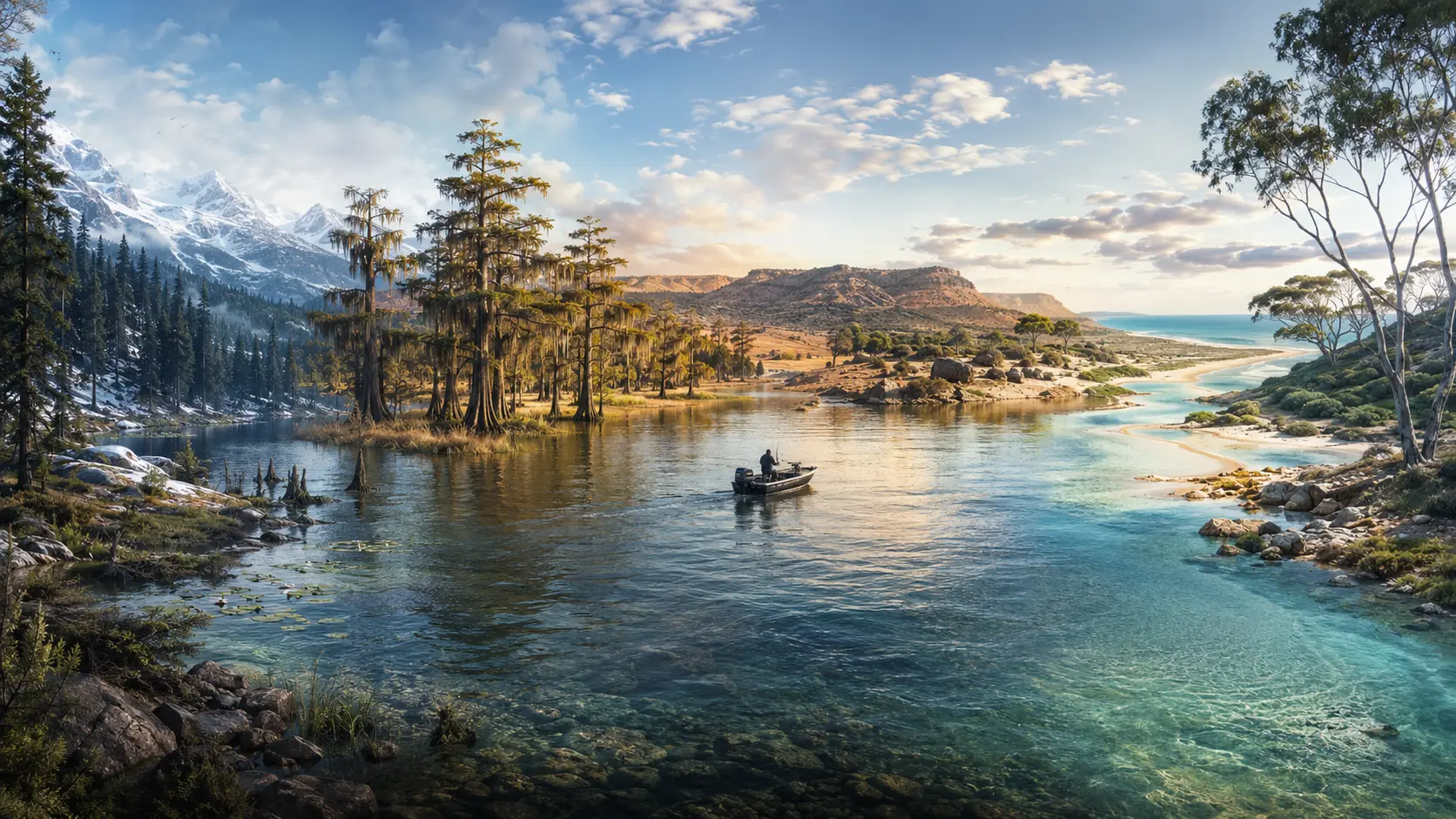
Regional species, habitat, water character, gear, and progression should agree. Location cannot be a menu label pasted over the same fish table. The strongest results come from a focused operating system, measurable quality standards, and human accountability—not shortcuts.
A Florida canal, Michigan lake, Arkansas river, Texas reservoir, and Australian coast should not produce the same species list under a different skybox.
Location becomes a mechanic when it changes what can appear, how the water behaves, what equipment makes sense, and what the player learns.
That regional contract is ReelWorld’s strongest search and product differentiator—and the part that requires the most disciplined sourcing.
Build a regional content contract
Each region needs a controlled table connecting water type, habitat, likely species, size bands, visual identity, conditions, challenge rules, and source notes. That table should drive content rather than merely documenting it afterward.
A curated game profile is not a real-time wildlife survey. The interface should preserve that distinction.
- Region and water class
- Species eligibility
- Size and rarity bands
- Habitat and visual rules
- Equipment context
- Source and review date
Protect real places and players
A location-aware game does not need to expose exact private fishing spots. Broad regions, public areas, player-selected context, and privacy-preserving location handling can support identity without publishing sensitive coordinates.
Location permission should be optional where possible, explained before use, and separated from exaggerated claims about what the phone can detect.
Let geography change progression
Regional collections, permits, challenges, tackle, and mastery can give players reasons to explore. A new region should introduce a new fishing problem rather than only a new background.
The progression should also work for players who cannot travel. Selected or unlocked virtual regions can preserve access while real location adds context rather than a paywall.
Use authoritative sources and human review
Official fish-and-wildlife resources can inform species and regulation context, but game content still needs a named reviewer and a last-checked date. A source can change, and simplified rules can become misleading when presented without scope.
ReelWorld should publish corrections as content updates and avoid implying that in-game availability is legal or current real-world fishing advice.
Frequently asked questions
What is a location-based fishing game?
It is a game where selected or permitted location context changes regions, species, habitat, challenges, or presentation instead of acting only as decoration.
Does a location-based fishing game need exact GPS?
No. Broad regions, selected locations, or privacy-preserving context can create regional identity without exposing precise coordinates.
Can ReelWorld tell me what fish are in real water?
No. ReelWorld’s regional profiles are game content, not live detection, scientific surveys, or fishing-regulation advice.
About this guide
This article was developed from iLLCo AI’s hands-on work building creator tools, multi-agent workflows, media systems, and business automations. AI assisted the production process; Aaron Allton reviewed, directed, and takes responsibility for the published guidance.