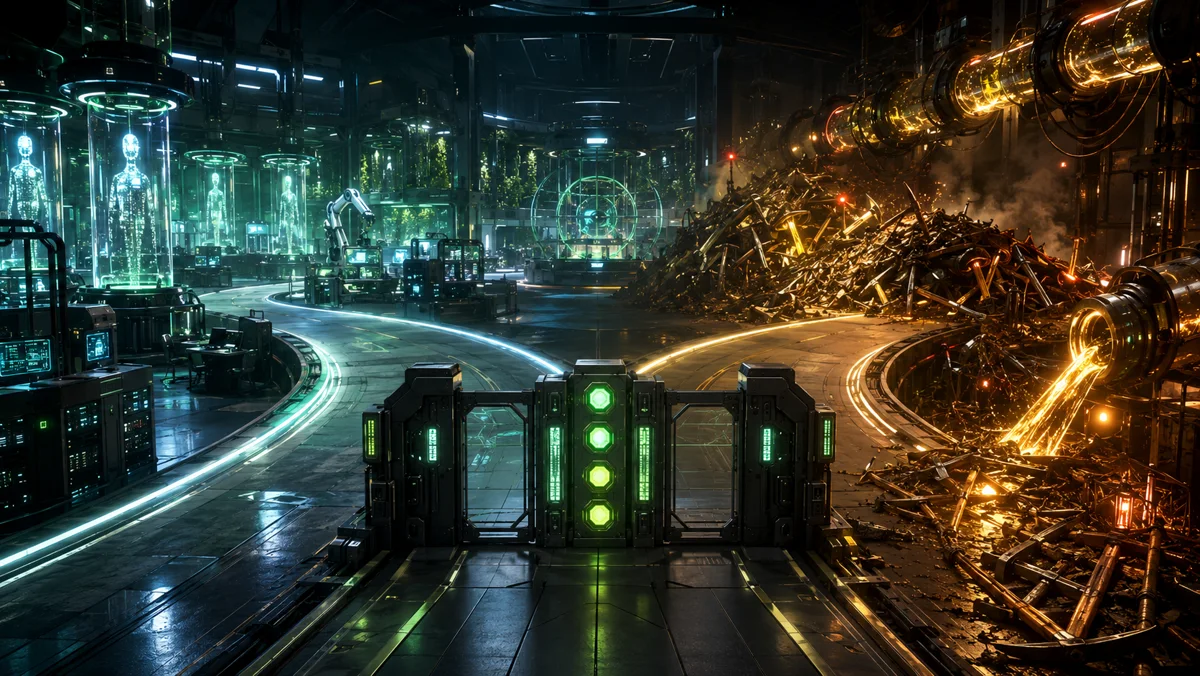
Rockstar’s handcrafted-world position is a warning against confusing generation with direction—not proof that every AI-assisted game pipeline is inferior. The real split is authored entertainment versus unaccountable output. The strongest results come from a focused operating system, measurable quality standards, and human accountability—not shortcuts.
Take-Two leadership has said generative AI has no part in what Rockstar is building for GTA 6 and emphasized a world made building by building and street by street. The strongest version of that argument is about authorship: detail matters because people chose why it exists.
But the headline can mislead. Take-Two has also discussed AI and machine-learning use across the company. Rejecting generated final content for one flagship is not the same as rejecting every tool that can accelerate search, testing, processing, or iteration.
Rockstar is right about the danger of substituting volume for intention. It would be wrong to turn that into a universal rule that small studios must avoid bounded AI assistance.
What happened
Public comments attributed to Take-Two CEO Strauss Zelnick draw a bright line around GTA 6: Rockstar’s world is handcrafted rather than procedurally or generatively assembled. More recent studio-preview reporting has reinforced the claim that generative AI was not used in the game’s development.
VERIFIED: this is the company’s stated production position. UNKNOWN: outside observers cannot independently audit every internal tool or define every borderline use from public comments alone.
Why it matters
GTA is judged on environmental storytelling, timing, performance, animation, and systemic interactions. An uncontrolled generator can create more content while making coherence harder to verify.
The statement also becomes a quality signal in a market where players worry about displaced labor, copied styles, inconsistent assets, and low-effort content. Handcrafted is part production philosophy and part brand promise.
Who wins and who loses
Rockstar wins if the final game’s density and polish make authorship visible. Studios using AI win when they can show faster iteration without weaker rights, performance, or design. Vendors selling one-click world generation lose when buyers demand playable evidence instead of screenshots.
Small studios lose if they imitate Rockstar’s labor model without Rockstar’s resources. Their strongest hybrid is human direction plus bounded automation and strict acceptance gates.
What happens next
The debate will move away from whether AI touched a project and toward which stage it touched, which data it used, who approved the result, and whether it improved the shipped experience.
Studios should describe AI use precisely. Concept exploration, code assistance, localization support, runtime dialogue, and generated final assets carry different risks and deserve different disclosure.
The iLLCo take: Rockstar is right about the standard
The winning lesson is not ‘never use AI.’ It is ‘nothing enters the game merely because it was easy to generate.’ WorldForge should preserve controlled coordinates, geometry, collision, art direction, performance, and legal review while using automation to reduce repeatable work.
Test the hybrid on one district. If players prefer it, the build performs, and reviewers can trace the sources and decisions, keep it. If generated variation makes the world less coherent or harder to ship, remove it.
Frequently asked questions
Did Rockstar use generative AI for GTA 6?
Take-Two and Rockstar leadership have publicly said generative AI did not play a role in building GTA 6 and have emphasized handcrafted world production.
Does Rockstar reject all AI?
No. Public comments distinguish generative content in GTA 6 from broader AI and machine-learning tools and pilots across Take-Two.
Should indie studios avoid generative AI?
Not categorically. Use it for bounded tasks only when rights, quality, consistency, performance, and human approval can be verified.
About this guide
This article was developed from iLLCo AI’s hands-on work building creator tools, multi-agent workflows, media systems, and business automations. AI assisted the production process; Aaron Allton reviewed, directed, and takes responsibility for the published guidance.