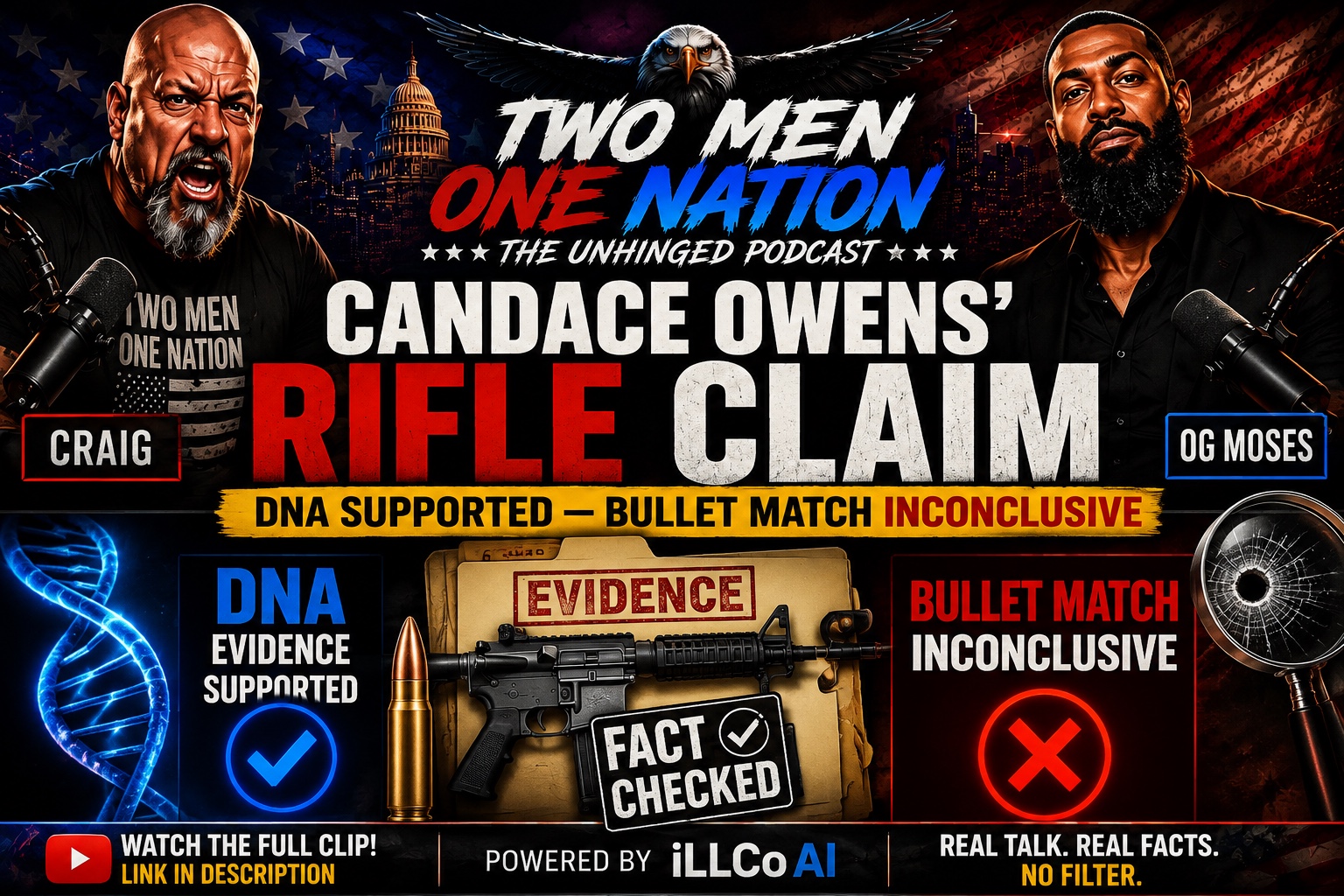
iLLCo AI and Two Men One Nation are shaping a human-led AI podcast workflow that maps arguments, researches material claims, and finds complete short-form stories. The strongest results come from a focused operating system, measurable quality standards, and human accountability—not shortcuts.
Long-form conversation is rich source material, but it is difficult source material. A single episode can contain a challenge that lands ten minutes late, a factual statement wrapped inside a joke, a useful analogy, a heated interruption, and a decisive response that conventional clipping tools never connect.
That is why iLLCo AI is working with Two Men One Nation — The Unhinged Podcast, hosted by Craig and OG Moses, on a production workflow built around conversational structure instead of arbitrary timestamps. The aim is to help an editor move from raw video to a traceable picture of what was argued, what was answered, and which moments can stand on their own.
This is not an automated truth machine and it is not a replacement for the hosts. The original recording stays central. The AI layer is designed to organize, surface research candidates, and prepare reviewable production decisions while people retain judgment, editorial control, and final responsibility.
The hard part is context, not transcription
A transcript is a useful record of words. It is not yet a record of meaning. If one person says, “That is not what I claimed,” the useful question is not only where that sentence appears. It is what statement they are correcting, how the earlier statement was framed, and whether the correction changed the argument.
That gap is where ordinary podcast editing becomes slow. A producer may scrub through hours of recording to recover the setup, reaction, reply, and later consequence. The proposed workflow treats those connections as production data that can be reviewed rather than rediscovered from scratch.
- Speaker turns and topic shifts
- Claims, questions, and clarifications
- Direct rebuttals and delayed replies
- Analogies, humor, and rhetorical framing
- Candidate moments that need human context
Debate intelligence starts with a relationship map
Instead of asking a system to select a loud timestamp, the workflow first assembles an episode map. A topic may branch into positions, supporting examples, objections, concessions, and unresolved questions. That map gives editors a way to navigate the conversation by idea as well as by time.
The important unit is not always a sentence. It can be a complete turn: a premise, a response, a clarification, and the payoff that lets a new viewer understand why the exchange matters. Connecting that sequence is what makes a short feel intentional instead of misleading.
- Topic → position → response
- Claim → research question → evidence status
- Point → counterpoint → follow-up
- Setup → tension → payoff
- Timestamped paths back to the original episode
Research only the claims that deserve it
Political and cultural conversations contain opinions, predictions, hyperbole, anecdotes, and factual assertions. Treating every line as a fact-check target would make the viewing experience noisy and would blur the difference between rhetoric and something that can actually be checked.
The system therefore uses a gate: identify material, specific, externally verifiable statements before research begins. When a claim is reviewed, the result should distinguish supported evidence, unanswered questions, missing context, and genuine uncertainty. A source card is a cue for informed review—not a substitute for it.
- Opinion and value judgment: do not label as fact
- Forecast or speculation: provide context when relevant
- Specific material assertion: prepare research candidates
- Evidence status: support, conflict, inconclusive, or insufficient
- Editorial review before any on-screen conclusion
Viral clips need an idea the viewer can follow
The most explosive line is not automatically the strongest short. Without its setup, it may confuse the audience, misrepresent the speaker, or create comments for the wrong reason. The better candidate is a compact story: the viewer immediately understands the issue, feels the tension, and receives a meaningful turn or payoff.
For Two Men One Nation, the clip workflow looks for complete exchanges rather than simply high volume or overlapping voices. It can flag an opening hook, the moment disagreement sharpens, the rebuttal, and the cleanest exit point for an editor to inspect.
- A clear premise within the opening seconds
- Real tension, curiosity, or an evidence reveal
- A response that moves the conversation forward
- Enough context to avoid manufacturing a false controversy
- A clean ending that invites a genuine reaction
The hosts remain the center of the show
Craig and OG Moses are not inputs to be flattened into a dashboard. Their experience, humor, disagreement, reactions, and personal cadence are the reason the show works. Any production system that makes every episode look and sound the same would erase the advantage it is supposed to protect.
That is why the visual direction follows a simple rule: give the viewer one important thing to look at at a time. When a host is making the central point, stay with the host. When a claim needs context, use a concise evidence card. When a response matters, bring the response forward instead of covering the screen in decoration.
- Original video and audio remain authoritative
- Synchronized transcript support, not a replacement performance
- Context cards only when they clarify the active idea
- Human review for speaker identity, claims, and final clip framing
- Clear separation between the show’s voice and production analysis
One recording can become a usable editorial library
When an episode is indexed by subjects and relationships, it becomes more than a three-hour file. A producer can revisit a position, locate the full exchange around a Short, find a previously discussed source, or build a later episode around an unresolved question without starting from zero.
That creates practical outputs at different depths. The full episode serves existing fans. Searchable notes help the production team. A well-framed Short introduces new viewers. Each output should point back to the original context rather than competing with it.
- Full episode with retained source timeline
- Searchable transcript and topic paths
- Argument and rebuttal review queue
- Research packets for material claims
- Short-form candidates with exact context windows
- A growing archive for future episodes and follow-ups
Why Two Men One Nation is a valuable real-world test
A sanitized studio demo is easy to organize. A live, opinionated conversation is not. Real discussions interrupt, switch lanes, blend personal experience with public events, and circle back to points that were made much earlier. Those are not flaws in the source; they are the conditions the workflow must handle responsibly.
Two Men One Nation gives the system a real production environment: long recordings, strong personalities, shifting stakes, humor, disagreement, and moments that need nuance. Building against that reality helps expose where the process needs stronger review gates rather than pretending the difficult parts do not exist.
- Long-form, unscripted exchanges
- Multiple rhetorical styles in one episode
- Fast subject changes and later callbacks
- Facts, stories, opinions, and jokes in close proximity
- High value in preserving complete context
The same model can help other creator teams
Debate intelligence is one expression of a broader creator-operations problem: people produce more material than they can responsibly review, organize, and reuse. Interview shows, livestreams, panels, training sessions, and founder podcasts all need better ways to turn their source recordings into coherent, approved assets.
The transferable lesson is not “automate the editor away.” It is to make the repeatable work visible, give each output a review owner, and preserve the link between a polished clip and the complete source. That is how content automation becomes durable infrastructure instead of a volume machine.
- Long-form video to reviewable content packages
- AI-assisted research and source organization
- Clip discovery with context safeguards
- Creator libraries that retain the source of each idea
- Human-approved publishing workflows
Frequently asked questions
What is debate intelligence for a podcast?
It is a human-reviewed production approach that organizes a conversation around topics, claims, responses, evidence questions, and timestamps so editors can understand the relationship between moments rather than treating the episode as a flat timeline.
Does the system fact-check every sentence?
No. The workflow is intended to separate opinions, predictions, rhetoric, and material verifiable assertions before research is considered. Relevant research is then reviewed before it appears as an editorial conclusion.
Can AI decide who won an argument?
No. A useful system can surface structure, evidence questions, and competing responses, but it should not present a subjective winner as an automated fact.
What makes a strong podcast Short?
A strong Short gives a new viewer a clear issue, genuine tension, enough setup to understand the exchange, and a payoff or useful turn—without cutting away the context that changes its meaning.
Can iLLCo AI build a workflow like this for another channel?
Yes. iLLCo AI designs human-directed creator systems for content analysis, research organization, clip review, publishing operations, and business automation. The first step is mapping the specific bottleneck and a safe measurable pilot.
About this guide
This article was developed from iLLCo AI’s hands-on work building creator tools, multi-agent workflows, media systems, and business automations. AI assisted the production process; Aaron Allton reviewed, directed, and takes responsibility for the published guidance.