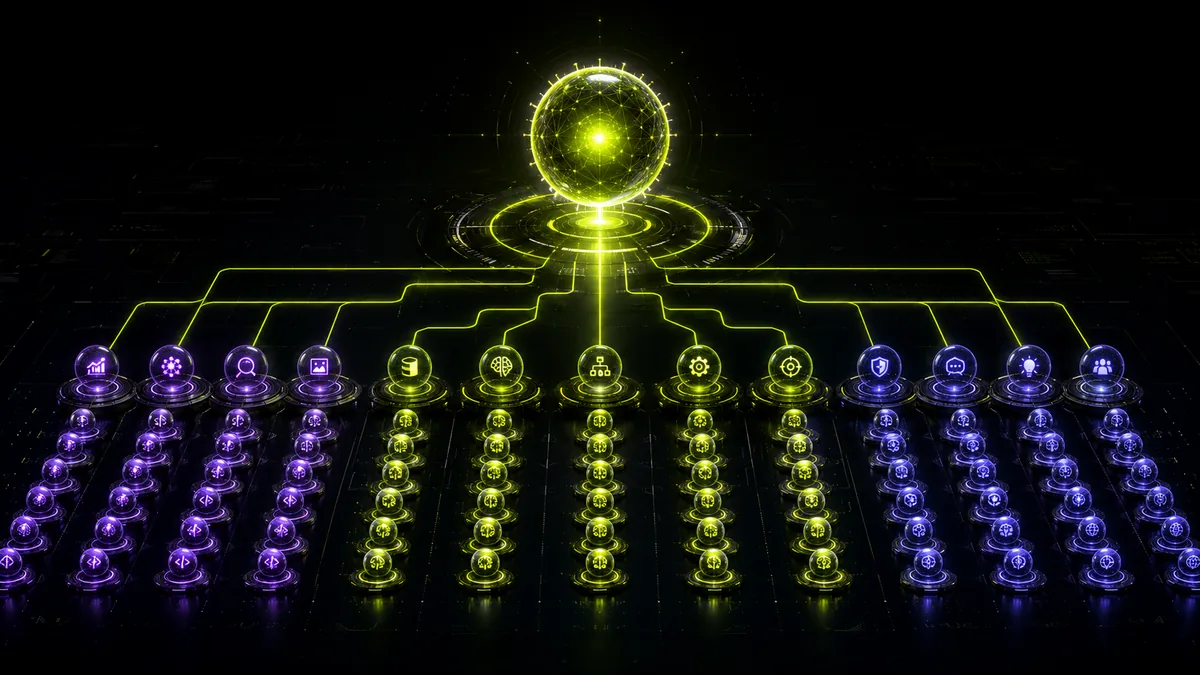
A practical architecture for specialist AI agents, shared operational memory, permissions, quality gates, evaluations, and human command. The strongest results come from a focused operating system, measurable quality standards, and human accountability—not shortcuts.
One giant AI assistant becomes a bottleneck. It mixes research, planning, production, review, memory, and action in the same context until the work becomes difficult to inspect.
An AI army is not a pile of bots. It is a command structure. Specialists receive narrow missions, work with limited tools, return structured outputs, and hand work through quality gates. A commander tracks state, resolves conflicts, and knows when a human must decide.
The business advantage is not the number of agents. It is the amount of reliable, reviewable work the system can complete without losing the original goal.
Start with missions and authority boundaries
Define the outcome before defining roles. Then assign the smallest set of capabilities needed to reach it. Every agent should know what it may read, what it may write, which tools it may call, what evidence it must return, and when it must stop.
An agent that can research does not automatically need permission to publish. An agent that drafts a customer response does not need permission to send it. Boundaries reduce both risk and debugging cost.
- Mission and definition of done
- Allowed data and tools
- Required output schema
- Escalation and stop conditions
- Explicitly prohibited actions
Separate production from independent review
The same agent that created an output is poorly positioned to provide independent approval. Add review roles for factual accuracy, policy, brand, security, and final quality when those risks matter.
Review agents should see the acceptance standard and evidence, not only the creator’s reasoning. They should be able to reject, request correction, or escalate rather than automatically improve the output and hide the failure.
- Creator produces against a specification
- Reviewer scores against fixed criteria
- Corrector receives exact failure reasons
- Human approves high-impact external action
Use shared memory as an operating record
Endless chat logs are not operational memory. Preserve decisions, evidence, source records, customer preferences, approved assets, evaluation results, and the current state of work in structured stores.
Memory needs ownership, retention rules, version history, and access control. A marketing agent should not automatically inherit private HR records. A new run should retrieve the smallest relevant context.
- Decision log and evidence links
- Project state and artifact versions
- Reusable standards and approved examples
- Corrections and evaluation failures
- Access, retention, and deletion policy
Design handoffs like APIs
A handoff should specify required fields, accepted formats, provenance, confidence, and failure behavior. If the research agent returns free-form prose and the script agent guesses which claims are verified, the swarm is fragile.
Validate handoffs before the next stage starts. Missing evidence should block a factual claim. An unapproved script should block narration. A failed render should block publishing.
- Schema validation
- Artifact and source identifiers
- Confidence and unresolved questions
- Approval status and version hash
- Retry and escalation behavior
Give the commander real observability
The commander needs more than a completion signal. Track agent runs, tool calls, latency, cost, errors, retries, approval state, and evaluation scores. Make stuck work and repeated failure visible.
Dashboards should answer: what is running, what is blocked, what changed, what needs human attention, what the system spent, and whether quality is improving.
- Queue and run state
- Trace and error records
- Cost and latency budgets
- Quality trends by task type
- Human review backlog
Scale only after the smallest team works
Adding agents increases coordination cost. Begin with one agent and tools. Split a role only when specialization, parallelism, permission separation, or independent review creates measurable value.
A five-agent system with clear responsibilities can outperform a 25-agent swarm built for spectacle. Architecture should follow evidence from the workflow, not a preferred headcount.
Frequently asked questions
What is an AI agent team?
It is a coordinated system of bounded AI agents that use tools, shared state, structured handoffs, and approval rules to complete a workflow.
How many AI agents should a business use?
Use the fewest agents that create clear value. Add roles for meaningful specialization, parallel work, permission separation, or independent review.
Does an AI army replace employees?
The strongest systems usually automate parts of work and expand human capacity. People remain essential for context, relationships, accountability, approval, and novel judgment.
What is the biggest multi-agent failure?
Poor coordination: unclear ownership, loose handoffs, conflicting state, excessive permissions, and no reliable evaluation or human escalation path.
About this guide
This article was developed from iLLCo AI’s hands-on work building creator tools, multi-agent workflows, media systems, and business automations. AI assisted the production process; Aaron Allton reviewed, directed, and takes responsibility for the published guidance.